Preface,
The Israeli settlement policy in the occupied West Bank is one of the most significant obstacles to achieving a just and sustainable peace. Since the occupation of the West Bank in June 1967, successive Israeli governments have adopted strategies and political measures aimed at consolidating the occupation of the Palestinian land. This has been achieved through supporting the construction and expansion of Israeli settlements over the years, providing financial and legal incentives for these settlements, and developing infrastructure for them—including water, electricity, communications networks, and roads—that connect the settlements to one another and simultaneously disrupt geographic continuity between Palestinian communities.
Although these strategies/measures varied—ranging from Labor-dominated government, a center-right or center-left governments —the settlement expansion policy remained consistent and systematic, even if the tools and methods have differed.
Policies pursued by the successive Israeli governments also included continued support for settlers through financial assistance, particularly for those residing in Israeli settlements in the Jordan Valley, as well as the facilitation of unauthorized construction in settlements and illegal outposts. In parallel, Israeli authorities have expanded what they refer to as “settlement jurisdiction areas” or “master plans,” increasing settler control over surrounding Palestinian land and reinforcing the long-term viability of these settlements. This expansion further seeks to establish geographic continuity both among settlements in the West Bank and between these settlements and those within Israel, notably through the development of extensive road networks and infrastructure.
The successive Israeli governments have further pursued to establish “Israeli industrial settlements” where settlers both live and work, in an effort to consolidate the demographic, geographic, and economic sustainability of these settlements.
Israeli settlement policy has a direct and negative impact on Palestinians daily life in the occupied West Bank. This impact is evident in the confiscation of land through various military orders and pretexts, as well as in the geographic fragmentation resulting from the expansion of settlements, the construction of bypass roads, the construction of the separation wall, and the establishment of military checkpoints along roads and at settlement entrances. While these measures are presented as security provisions for Israeli settlers, they have severely curtailed Palestinians’ freedom of movement between their communities.
In addition, the long-term Israeli control and seizure of water resources have negatively affected the agricultural sector in the West Bank, resulting in water scarcity and reduced agricultural production.
2025 Statistics !
In 2025, the occupied West Bank witnessed a significant and unprecedented escalation in settlement expansion, as reflected in the large number of settlement plans published for construction in Israeli settlements.
Data from the Applied Research Institute – Jerusalem (ARIJ) show that, 251 settlement plans were published in 2025; including projects for the construction of over 31,000 new settlement units across various West Bank settlements; along with the confiscation of more than 33,000 dunums of Palestinian land for that purpose. This includes the construction of new bypass roads, establishment of industrial settlements, and other public buildings and parks. These figures reflect the Israeli systematic policy through which Israel seeks to impose a new demographic and geographic reality on the Palestinian land.
Several Palestinian governorates emerged as key targets of Israeli settlement plans, with the highest number of proposed units concentrated in strategically important areas—whether due to their geographic location, urban growth, or natural resources; most notably in the governorates of Jerusalem, Bethlehem, and Ramallah, respectively.
This aligns with the Israeli plan commonly referred to as “Greater Jerusalem,” under which the Israeli occupation authorities seek to annex the major settlement blocs surrounding the city of Jerusalem—including the Ma’ale Adumim settlement bloc to the east, the Gush Etzion settlement bloc to the southwest, and the Givat Ze’ev settlement bloc to the northwest—into the unilaterally and illegally expanded Jerusalem municipality boundary of 1967, to become the city’s new boundaries, through the construction of the Israeli Segregation wall and intensified settlement construction. Figure 1
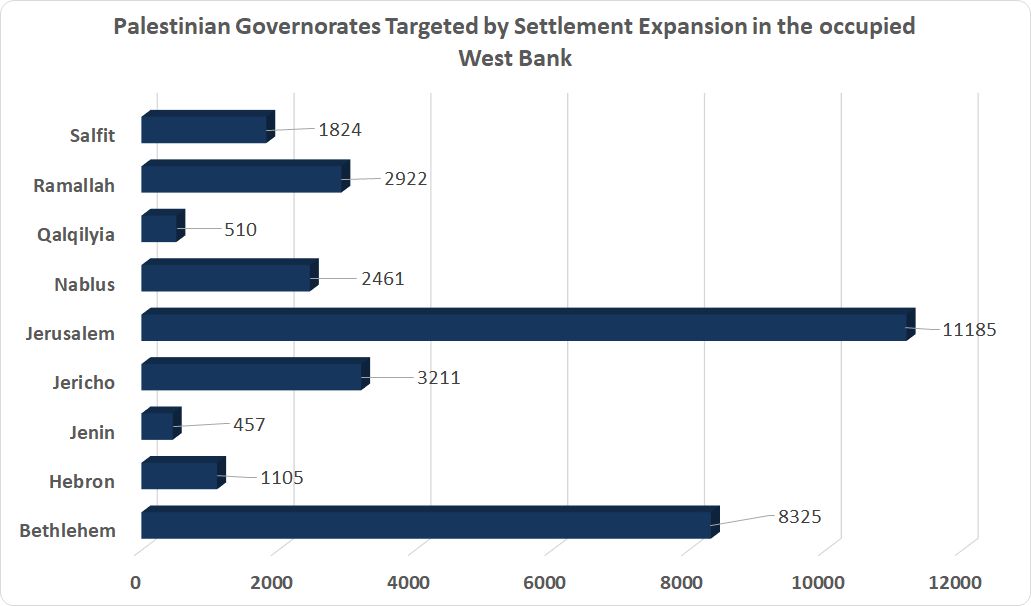 Figure 1 illustrates the distribution of Israeli settlement plans according to their locations in the Palestinian Governorates.
Israeli Settlements Most Targeted by expansion
The issued plans show that Israeli targeting through settlement construction has been concentrated in a number of settlements within the previously mentioned governorates, with certain settlements standing out in terms of the number of plans issued for them. In Bethlehem Governorate, for instance, the settlements of Beitar Illit, Efrat, and Ma’ale Amos were among the most targeted in terms of the number of proposed plans. In Jericho and the Jordan Valley, the plans mainly focused on the settlements of Ma’ale Ephraim and Metzpe Yeriho.
In Jerusalem Governorate, the largest share of settlement plans was concentrated in the settlements of Givat Ze’ev, Ma’ale Adumim, Gilo, Givat Hamatos, Neve Ya’akov, Ramat Shlomo, and Pisgat Ze’ev, particularly targeting settlements located within the unilaterally and illegally expanded boundary of Jerusalem Municipality after 1967.
In Qalqilya Governorate, the settlement plans largely targeted Alfei Menashe, Kedumim, and Karnei Shomron, while Modi’in Illit was the most prominent in Ramallah Governorate in terms of the number of issued settlement plans. Settlement activity was also concentrated in Salfit Governorate, particularly in the settlements of Ariel, Barqan, and Etz Efrayem. In Nablus Governorate, settlement plans were focused in the settlements of Eli and Elon Moreh.
In Conclusion
Settlement expansion in the occupied Palestinian territory is not merely a routine activity, a temporary policy, or linked to a specific Israeli government. Rather, it is a systematic and ongoing approach that has continued throughout the years of Israeli occupation, from 1967 to the present. Successive Israeli governments have adopted this policy through different methods, but despite the variations in tools and approaches, the ultimate goal remains the same: to consolidate and strengthen the Israeli settlement presence on Palestinian land—whether through urban construction, expanding the settlements’ Jurisdiction areas, developing infrastructure, or other settlement activities.
Article 49 of the Fourth Geneva Convention of 1949 prohibits an occupying power from transferring parts of its civilian population into the territory it occupies. United Nations Security Council resolutions, including Resolution 446 (1979) and Resolution 2334 (2016), reaffirm that the establishment of settlements in occupied territories “has no legal validity” and constitutes an obstacle to achieving a just and lasting peace in the region. Despite this, the Israeli Government continues its settlement expansion, disregarding all international resolutions.
Prepared by:
The Applied Research Institute – Jerusalem